Sunday, December 21, 2014

Metafiction : Severing the String

Used some parts of "Write a daily diary in the voice of the following character Thomas Mortenson."


           I let out a deep breath. Feeling my lips tremble as I saw the white puff that have come out of my mouth vanishing into the crisp night air. I could feel my pulse against my neck, quick and powerful, as if it knew that it had limited amount of time left. Some powder fell onto my shoulder. I looked up and saw a roughly made hole. And from that hole, a thick rope protruded. Stretching down until it wrapped tightly around my neck. Again I took a deep breath, feeling the tension on my neck sharply increasing.
           
           It all happened several days ago, from the very moment my symptom of narcolepsy worsened. December 12th, 4 days from today another sleep attack happened during the geology class. However, that day's event was different from the other days. Unlike the normal, previous times when I looked back at my own past, today I found myself in another person's body. "Crack!," I opened my eyes and found myself lying in a hospital all dressed up in white clothes. Words of shock and disbelief erupted around me. It was some time before I realized I wasn't the six year old Thomas, but a middle-aged man called Fred. It was that I had been in coma for 6 years, but today I suddenly regained consciousness. I was listening to the astonished babbles of my supposed family when I suddenly woke up, sprawling in my geology class.
           
            The school has ended for the day and I was standing in from of the main gate, waiting for something. The moment my watch beeped, telling me that it was 5'o clock, a black car showed up from the corner, gliding smoothly towards me. It was always like that, 5'o clock. Not a second late, not a second less. The door opened and I climbed in. As usual the tanned window between the front and the back seat only able me to notice that there were two people in the front. Since I was about 3 years old, I have been under heavy surveillance from some kind of government agency. Whether, it was due to my somewhat exceptional intelligence or some other factors in me, I did not know. All I knew was that I was supposed to be under surveillance till I come of age and therefore, be able to decide my future actions. I don't know what happened to the rest of my family, some say that they were all lost due to some tragic accident, while some say that I have no such thing in the first place. Anyhow, there were nobody to greet me when I arrived home from school, I had a whole flat to myself. Thinking about this, the memory of me lying in bed surrounded by my own family showing relief at my awake bloomed in front of me. I felt a twinge of jealousy towards that man.
            
           The car slowly slowed down and the familiar surroundings began to pass around us. Soon, the car reached a stop and I opened the door and climbed out. The two guys in the front nodded, it was the best they could do to show their affection. I shrugged and slammed the door. I fumbled for my keys and finally managed to fish it out from my pocket. As I unlock and opened my door, something felt different. Something seems to swoop down on me and seemed to pass right through me. It gave shivers down my spine. I cried for the first time that night.

           The next day I found a white clean paper on my desk in the first class and a pen in my hand, now there is one thing to do. As I draw for two hours, the teacher came next to me and said "Tom, participate in class don't do other things." I don't have the memory after that. I guess I slept as I heard it. It was during the 7th class when I regained my consciousness. I found the paper with an unfinished dessin, a picture of a boy, a boy with his heart torn out. I shrieked when I saw the picture and freaked out. The next moment, I opened my eyes and looked up into a familiar wallpaper, it was some time before I realized that it was dark outside and I was in my room, in my house. It was dead silent in the house. I was just about to get up from my bed when my head spun and I was swept into the pool of narcolepsy again.
           "Crack" I opened my eyes and once again found myself lying in the hospital bed. Another round of shock and buzz ran through the hospital again. This time I was able to hang around in "Fred's" body for some time. I learned that I was 34 years old and had a family with two kids. My supposed wife's name was Christina and two kids Hank and Sue, 10 and 8 respectively. I found that I was staying Liverpool, England. I was able to stay in this body until my family rushed in, hearing the new that I have again gained consciousness. The relief they all showed at my awake, my wife and mother crying for my safety, were all new for me. It gave me the feeling inside me that I have never felt before in my life. A feeling that I have only read in books. A feeling may call 'love,'
           
            For the following days, I have tried my best to fall into narcolepsy as much as possible. Through this process I was able to find out that I was able to fall into narcolepsy when I wanted to get out of the situation my original body was in. One example was my class. The fixed and hardy feeling the classroom gave me, along with the boring lectures that I had to listen to was one of the main factors that I was going into narcolepsy at classes. Another fact that was able to learn was that I was able to hold the consciousness in Fred's body until I fall asleep in that body. Through this experiences I was able to stay more in Fred's body than I was in my own body. I heard that my coma symptoms were getting remarkably better as time went on and I was a really lucky case, waking out of the comma.
            
           During my time as Fred, I burrowed a Ipad from Christina and Googled "Thomas Mortenson." No such name came up. It seems as if the Russian Government have erased me from the surface of the world. A deep taste of bitterness filled in my mouth. I almost cried out, furious. The more I longed to stay in Fred body forever.
           
            And here I am again, in my room with my window open, looking out at the night view of Moscow. I looked out at the endless lights that filled in front of my eyes and wondered if anyone would miss me if I was gone. And I thought about Fred. How, his families would react if Fred was to never open his eyes again. Thinking about this, some kind of a knot that seemed to be inside my chest suddenly seemed to resolve, the answer to this suddenly seemed clear and simple. As I was swept once again to narcolepsy I kicked my foot and tipped over the chair I was standing on.

"Crack!"

           I opened my eyes, into the blinding light, with the familiar strong smell of disinfectant piercing my nostrils....


Friday, September 19, 2014

The University of Chicago 2014-15 Essay Questions: Essay Option 3.

Essay 3.Little pigs, french hens, a family of bears. Blind mice, musketeers, the Fates. Part of an atom, laws of thought, a guideline for composition. Omne trium perfectum? Create your own group of threes, and describe why and how they fit together. 

Two Edged Sword : War, Lethal Accidents, and Radioactive Technology.


     War, lethal accidents, and radioactive technology. These collection of words construct a very ironic meaning unlike what the norm would think. While, there is some truth in that these three factors have contributed greatly in degrading the qualities of human lives, it is also these very factors that have stimulated the most dramatic development in medical studies throughout the history. In other words, every victim related to these three factors has contributed one way or another to set up the foundation that is and will continue to save myriads of human lives.

     When skimming through the heavy biology textbooks we are able to take glimpses of pictures containing human anatomy. When looking at these pictures we are taken aback at how detailed these descriptions are. While some might argue that these were possibly due to the recent development of imaging techniques, these pictures have been existing long before such imaging techniques have even been invented. So what enabled such descriptions? The real reason lies in the inhumane actions that have taken place during times of wars and colonization. The highly detailed drawing of the human anatomy is actual eye to eye, first handily drawn drawings of a dissected organs of captured hostages. A famous example of this is the "Unit 731" associated in the Imperial Japanese Army that undertook lethal human experiments during the Second Sino-Japanese War(1937-1945) and WW2. It is said that they referred the each individual person used in experiments with the term "log." Furthermore it is said that the "Unit 731" undertook bisections with these "logs" ,subjected to various diseases, without anesthesia. Although there is no doubt that these actions are outrageous, inhumane, and should not happen ever again, it is also true that because of these actions we were able to know the exact anatomy of such organs and the effects various diseases have on them. Hard to admit, but these findings have helped us greatly throughout the years.  

Unit 731

     The lethal accidents have also contributed considerable amount in finding each functions of the human body. The basic logic is that when an accident causes a particular part of the victim's body to lose its function, doctors observe and test this victim and try to find a part of him that has become abnormal. Thus conjecturing that the part of harm in the human body is the place that manages the correlates failed function. Through repeated observation doctors are able to conclude what particular function of a particular body part manages. An example of this is the accident of one man(Phineas P. Gage) that worked in a construction site. One day a dynamite was set of at the wrong time and a steel rod penetrated right through the man's skull, just where his frontal lobe was located. Miraculously the man survived from that ordeal and recovered. However, a very distinctive change occurred in his personality. Once a man famous for his kindness and benign nature, this accident changed this personality completely. The man began to demand such selfish requests, expressed his immediate instinctive feelings, and became a very grouchy. Through such observation along with other similar incidences, the researchers were able to conclude that the main function of the frontal lobe was associated with human's solution thinking and consciousness.

Phineas P. Gage

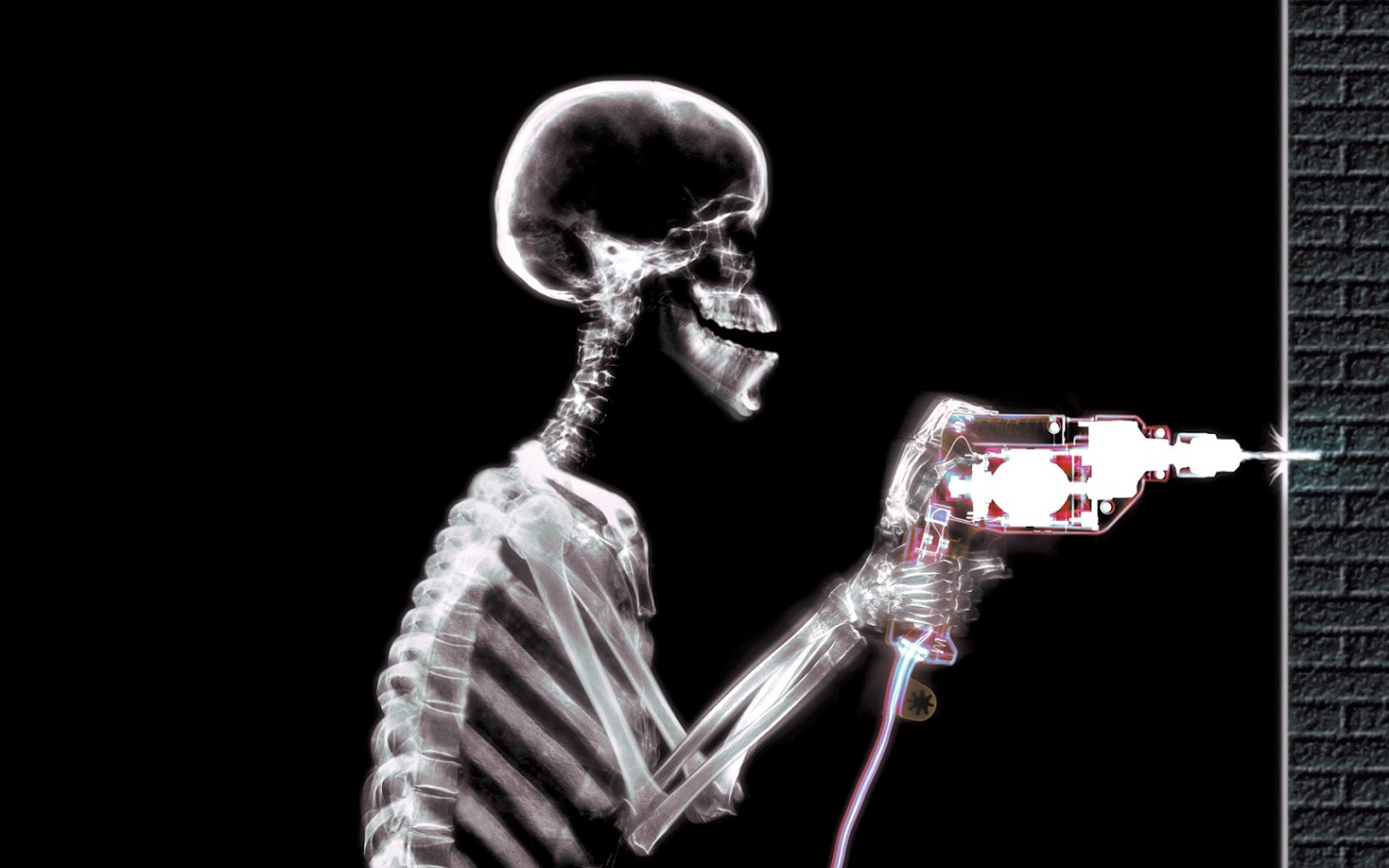
     While the development of radioactivity techniques have brought upon the creation of nuclear bombs and other weapons that have stolen millions of lives, other instruments made from such technology have made a surmountable development in the field of medical research. Such example is the use of X-rays and such machines called PET. Basically, these machines use the property of radioactivity rays that they have short wavelengths and large energy that able them to pass through the human body. On the other side of the origin of these waves there are receptors that receive these waves and through complex algorithms, computing the texture and state of the penetrated body, displays a digital picture on the computer screen. This rather simple technique has enabled the doctors to become aware of such diseases or injuries without the need of surgery, and a higher accuracy in the overall diagnosis of a patient.

X-rays

     There is a saying that with brighter light there comes a darker shadow. Such is the way of these three terms ; War, lethal accidents, and radioactive technology. It is a fact that these factors have  once brought upon undesired results to the rest of the world, however it is also a fact that they have contributed in saving millions of potential and present lives. Nothing is ever perfect. Such is true with our lives. While some aspect of an objects or experiences might be beneficial, there are bound to be some unforeseen aspect about that factors that are causing more harm than good. Therefore it all comes down to the user, us, who are capable of manipulating these subjects or objects. To diminish the harms as much as possible and at the same time amplifying the benefits.


Sunday, July 7, 2013

Last Assignment! (hopefully :)) : Minjok

Minjok ; the past and the future


The concept of ‘Minjok’ is deeply rooted in our lives as Koreans. We use this idea to describe and explain Koreans’ unity in many different circumstances from sports events to Korean literature. Yet, not so many people fully understand the concept of ‘Minjok’ or Korea’s ethnic nationalism. This lack of understanding might prove to be disastrous. Only by understanding how the concept of ‘Minjok’ came about and by scrutinizing its relevance to contemporary Korea are we able to fully understand and to successfully apply the concept to our past, present, and future. 


The best starting point of our analysis would be to consider the meaning and the history of the term ‘Minjok’. In essence, Korean ethnic nationalism (Minjok) is a sense of Korean identity based on the belief that Koreans are whole and unified through several important factors such as common bloodline and a shared, distinct culture. Simple as it seems, the background of the term is much more complex.


Identitiy

  The concept of ‘Minjok’ started to emerge among Korean intellectuals in the early 20th century. During this time, Korea was under Japanese colonial rule. Before the Korean-Japanese treaty of 1905, when Korea’s right to govern was mostly taken away, Japan went through a period of significant modernization. Under the newly established ‘Meiji’ government, Japan followed the footsteps of Germany and adopted many of its political and economic strategies. By the early 20th century, Japan became an Asian superpower and started to expand its borders through colonization.  Japan used the term ‘Greater East Asia Co-Prosperity Sphere’ to justify its actions against other countries, claiming that Japan is promoting the cultural and economic unity and progress of the East Asian race. The underlying purpose was to bring people under Japanese nationalism. Korean intellectuals rejected this notion and tried to promote Korean ethnic nationalism, making use of the newly phrased term ‘Minjok’ in their efforts to do so.

The Japanese Empire
Some of the main figures of the Korean independence movement who used the concept of ‘Minjok’ are Shin-Chae-Ho and Lee-Gwang-Soo. The reason behind their importance is not solely based on their usage of the term, but their method of utilizing the concept and the significant impact of their works, even to our present-day. The main approach they took trying to promote the notion of ‘Minjok’ was by using historical figures in Korean history.


Shin-Chae-Ho
Lee-Gwang-Soo
For example, the scholar Shin-Chae-Ho published a book, <Ul-Ji-Mun-Duk (을지문덕 乙支文德) >where he wrote about an historical event where the Chinese Sui invaded Goguryeo. Here, Shin-Chae-Ho described Ul-Ji-Mun-Duk’s heroic act that was a key factor in winning the Sal-Su-Dae-Chub, a historical battle that brought Goguryeo-Sui war to an end for Goguryeo’s victory. He particularly emphasized the general’s character such as his courage and his sacrifice to the nation from foreign invasion. Another scholar named Lee-Gwang-Soo wrote a book called <Lee-Soon-Shin-Jun>, a story of a famous general during the Korean-Japanese war (1594), also a Korean Minjok Leadership Academy figure. Lee-Gwang-Soo similarly praised Lee-Soon-Shin for his heroic acts. There are also lots of other scholars who wrote stories of historical figures, but they all have in common that by emphasizing the patriotic side of the great men in Korean history and tried to define the characteristics of the Korean people under the concept of one Minjok. By trying to emphasize and define the Korean ‘Minjok’ as hard working, patriotic, etc, they were able to make great contributions to strengthen and specify the already existent concept of Minjok in the Korean society.

Lee-Soon-Shin

Up to this point, this act of Korean ethnic nationalism wasn’t so special inside the global community. Other countries such as France, Germany, and Japan also had this sense of unity in their nation. However, as time passed and WWII came to an end, the sense of nationalism weakened. This was presumably because their fundamental belief was based on a single community, not a strong bloodline like the Koreans. Furthermore, the foreign countries concept of Ultra-nationalism and Nazism crumbled through the defeat of the WWII, while our concept of Minjok remains solid for our belief as mentioned before is focused on the bloodline and culture.


Collapse of Nazism


The idea of ‘Minjok’ reaches its peak in the 1960s during president ‘Park Chung-Hee’’s term in office. President ‘Park-Chung-Hee’ emphasized the concept of ‘Minjok’ in order to legitimate his foreceful ruling. To be more specific, he stressed the loyalty of the citizens to their nation, which meant that the people of Korea had to take in sacrifices meant for development and a promising future of Korea. This was done by bringing all people under the idea of ‘Minjok’.
Statue of Lee-Soon-Shin
Still, in present day Korea, there are many traces that we can find of his dominant authority and his emphasis on the concept of ‘Minjok’. For example, the statue of Lee-Soon-Shin in Gwang-Ha square in Seoul was built during the Park-Chung-Hee era. The president emphasized Lee-Soon-Shin as he was a key symbol of Korean history concerning one’s sacrifice to Korea. He died in his last battle against the Japanese marines. Furthermore, every school that was built during this period has a statue of Lee-Soon-Shin or Dan-gun, one who is said to have established the first Korean nation. My middle school also has a statue of Dan-gun and this also stresses the loyalty and sacrifice for the country as we all gather and salute to the flag and the statue every Monday. Other examples are the Korean National Pledge that was created in 1968. The pledge says that one must sacrifice everyday for the nation and the glory of our people. So as you can see, during this period, a sense of Korean nationalism or ‘Minjok’ was enforced into the modern day Korea.
[1] 신선희(Sun-Hee Shin), <근대 초 위인전을 통해 본 한국인의 정체성 형성 방법>, 3-5
http://congress.aks.ac.kr/korean/files/2_1357707735.pdf


(Korean National Pledge)

This is where the ‘Necessary Illusion’ can be added into the context. The emphasis on sacrifice to the country could be said as a ‘Necessary Illusion’ used in order to cover up the real problem. In this case, the real problems during the Park-Chung-Hee era were labor and democracy problems. By stressing the unquestioning obedience and sacrifice of the Korean people, the urgency and importance of labor and democracy problems were covered-up. So, the ‘Necessary Illusion’ could be said as a crucial factor that blocked democratic development of the Korean society. To rephrase, the concept of ‘Minjok’ was used as a ‘Necessary Illusion’ by the government at that time to cover up the pressing matters such as democratic policy adoption and labor rights.

Jeon Tae-il 
So this is where we face a very important and difficult question. Does the end justify the means? While the forceful development of the past has ignored the human rights, there aren’t so many people who are angry with the amazing economic development we have gone through in half a century. However, we cannot say that end justifies the means. To back this argument the situation of labor in the past and present could be used. In the 70’s the working environment of the labors was in a serious state, where the sanity and the safety of the workshops were not properly protected by the government. Angry about this situation a worker called Jeon Tae-il commits a suicide by burning himself in order to notify the situation of the workers in Korea in and out of the nation. This problem between the employees and the employers is still eminent today. The labor problems happening inside companies such as 쌍용(Ssangyong), and 현대(Hyundai) is the consequence of such problems not solved in the past, specifically the excessive emphasis on the concept of ‘Minjok’ and the sacrifice required by the government. Therefore, the end does not justify the means. The Necessary Illusion is only covering up the problem for now, but not really solving the problem.

The concept of ‘minjok’ could not be said that is meaningless in the present Korean Society. There are certainly some elements of the concept that could be considered positive to our society, such as in times where our nation became one, cheering for the national team in the 2002 world cup, etc….. However, the concept of ‘Minjok’, can be said to be incompatible in many areas in today’s situation. There are two main folds to why I think this concept is incompatible; it does not fit into the trend of globalization, and it effects negatively to the problem of Korean unification.

2002 World Cup


Of course I am not saying that the globalization is always a good thing. There are certainly needs for the concept of nationalism as it can filter what to take in or not. However, a successful and a more idealistic globalization is when every other race, culture and people can coexist peacefully inside one society. The concept of ‘minjok’ in Korea is disturbing such coexistence for we emphasis to our children from a very young age that we are a single race and that we have a  unified bloodline. These factors of ‘Minjok’ is creating disharmony between the Koreans and foreign labors, which means that we are losing valuable potential human resources which could haul our economy to a more developed state. The disharmony extends to foreign cultures, foreign ideologies, etc. Another example of such disharmony is the way Koreans treat to foreigners when some accidents happen to our citizens. In 2002, two female students were killed by a tank from the US army, by accident. Outraged by this accident, the citizens of Korea began to show their anger by assaulting random foreigners whom weren’t even Americans. Looking at these past incidents, it is clear that the concept of ‘Minjok’ and unity is causing disruption for a peaceful relationship with foreign countries, cultures, and people, and it is certainly against the ideals of a successful globalization. Korea should modify their concept of ‘Minjok’ as a strong, unified, distinct group. Realizing that this stubborn concept is incompatible to our present day, we should try to open up the concept of ‘Minjok’ to other people who share the same sense of belonging to Korea.

The increase of foreigners in Korea


Secondly, the concept of ‘Minjok’ is actually preventing the unification of North and South Korea. It is true that the ‘peaceful minjok unity’ is the fundamental principle for peaceful unification. However as 60 years have passed since both Koreas got divided, there are not much factors to find in common between these two countries nowadays. Language, culture, idea is becoming different every day. Considering this fact, the ongoing efforts of unification under the theme of ‘Minjok’ could be somewhat meaningless. While the concept of ‘Minjok’ in both Koreas is focused on the fact that North and the South Korea are the same as we share the same bloodline, the reality is not. So rather than just stressing this incompatible concept of ‘Minjok’ as a key to reunification, trying to focus and develop on what little is left that can be said as common to the two Koreas, it would be more efficient to analysis the differences between the two countries and try to overcome these differences. Overall that solution would be more suitable for the present situation.

Efforts for Unification

To put it into a nutshell while the concept of ‘Minjok’ started as a mere motive to resist the treachery of Japanese – Empire, it has caused much more fundamental impacts to our history and the Korean Society. Though the concept of ‘Minjok’ might have been effective in the past, it is beginning to show signs of problem in our modern society as the necessary illusion only covers up the problems, not solving it. Such example is the problems of labor rights. Now the time has come for us Koreans to rethink about the term ‘Minjok.’ Of course I’m not saying that we should completely rebuild the meanings of the term, but to cut out the parts that is lacking today’s trend in the globalized society. In addition to add factors that could lead to a more harmonious relationship between the foreign society and Korea. Everything resembles Janus, there are always some factors that might benefits or otherwise harm the society. This logic could also be applied to the concept of ‘Minjok’, while the term ‘Minjok’ has both sides of benefit and harm it is the job of today’s people to minimize the harms and to maximize the benefits.
Janus

Wednesday, July 3, 2013

Finals !!


Tired.....


Zzzzzzzzzzzz.....

Tuesday, June 25, 2013

The Golden Gate Bridge


Balancing on that red thin rope

Imagining myself as a clown

Wish I could go back

to the Past

Saturday, June 15, 2013

Introducing a Book!

<The Selfish Gene>


This book "The Selfish Gene" was published

in 1976. At that time this book was a

sensation to the field of Biology. For what

the author Richard Dawkins argued was

completely different than what was

generally believed in that society at that

period.

To summarize the approach Richard Dawkins took is simply a new perspective; to look at

the matter at a very small scale, in this case genes.

Richard tried to explain the whole phenomenon of the biological society from the scale of

genes. He believes that everything that is happening around this world is due to the

selfishness of individual genes.

For example, the scenes where we see the same species helping each out such as

relation between mother and child. On the surface this might look far away from

selfishness. For they are helping 'others' not themselves. But this is where Richard

Dawkins throws the question. "Are they really 'others?'" The answer is ; "no"  By looking

from the perspective of genes the genes of the same species especially the one that are

directly connected is the same. By helping 'others' ultimately it is the same act as helping

themselves.

Like this Richard elaborates his own analysis of how he interpreted the ecosystem

through the lens of his 'gene' point of view.

Even though 30 years have passed this <The Selfish Gene> is still in the bestseller lists.

There got to be the reason for this. The reason is that his theory developed 30 years ago

still have some points that could be further elaborated in the 21th century. So to put it

into a nutshell, everyone whether they are interested in biology or not could not miss the

chance to read this fascinating book of Richard's!